Why Intermittent Fasting Works for Weight Loss
The science behind fasting

In our body, nothing happens by accident. Every single physiologic process is a tight orchestration of hormonal signals. Whether our heart beats faster or slower is tightly controlled by hormones. Whether we urinate a lot or a little is tightly controlled by hormones. Whether the calories we eat are burned as energy or stored as body fat is tightly controlled by hormones. So, the main problem of obesity is not the calories we eat, but how they are spent. And the main hormone we need to know about is insulin.
Insulin is a fat-storing hormone. There’s nothing wrong with that — that is simply its job. When we eat, insulin goes up, signaling the body to store some food energy as body fat. When we don’t eat, then insulin goes down, signaling the body to burn this stored energy (body fat). Higher than usual insulin levels tell our body to store more food energy as body fat.
Hormones are central to obesity — as is everything about human metabolism, including body weight. A critical physiological variable such as body fatness is not left up to the vagaries of daily caloric intake and exercise. If early humans were too fat, they could not easily run and catch prey, and they would be more easily caught themselves. If they were too skinny, then they would not be able to survive the lean times. Body fatness is a critical determinant of species survival.
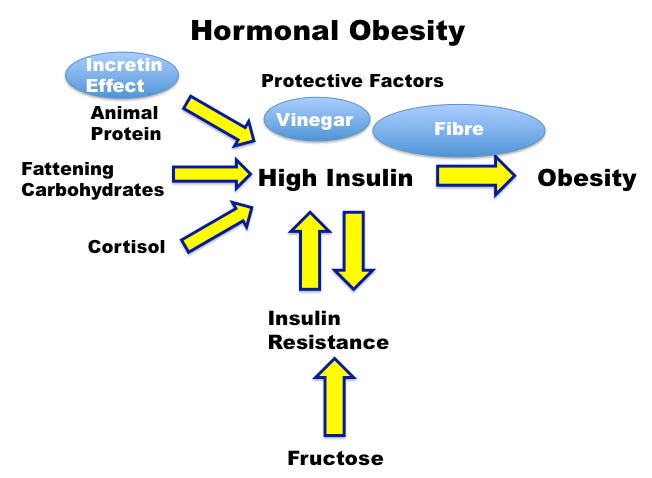
As such, we rely on hormones to precisely and tightly regulate body fat. We don’t consciously control our body weight any more than we control our heart rates or our body temperatures. These are automatically regulated, and so is our weight. Hormones tell us we are hungry (ghrelin). Hormones tell us we are full (peptide YY, cholecystokinin). Hormones increase energy expenditure (adrenalin). Hormones shut down energy expenditure (thyroid hormone). Obesity is a hormonal dysregulation of fat accumulation. We get fat because we’ve given our body the hormonal signal to gain body fat. And those hormonal signals go up or down according to our diet.
Obesity is a hormonal imbalance, not a caloric imbalance.
The Problem is Insulin
Insulin levels are almost 20 percent higher in obese subjects, and these elevated levels are strongly correlated to important indicators, such as waist circumference and waist/hip ratio. But does high insulin cause obesity?
The “insulin causes obesity” hypothesis is easily tested. If you give insulin to a random group of people, will they gain fat? The short answer is an emphatic “Yes!” Patients who use insulin regularly and physicians who prescribe it already know the awful truth: the more insulin you give, the more obesity you get. Numerous studies have already demonstrated this fact. Insulin causes weight gain.
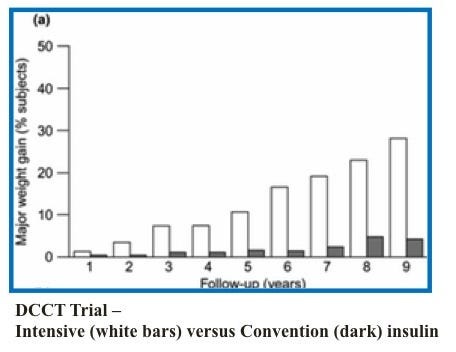
In the landmark 1993 Diabetes Control and Complications Trial, researchers compared a standard dose of insulin to a high dose designed to tightly control blood sugar in type 1 diabetic patients. Large insulin doses controlled blood sugar better, but what happened to their weight? Participants in the high-dose group gained, on average, approximately 9.8 pounds (4.5 kilograms) more than participants in the standard group. More than 30 percent of patients experienced “major” weight gain.
Prior to the study, both groups were more or less equal in weight, with little obesity. The only difference between the groups was the amount of insulin administered. Insulin levels were increased; patients gained weight. Insulin causes obesity: as insulin goes up, the body weight goes up. The hypothalamus sends out hormonal signals to the body to gain weight. We become hungry, and we eat. If we deliberately restrict caloric intake, then our total energy expenditure will decrease. The result is still the same: weight gain.
Once we understand that obesity is a hormonal imbalance, we can begin to treat it. If we believe that excess calories cause obesity, then the treatment is to reduce calories. But this method has been a complete failure. However, if too much insulin causes obesity, then it becomes clear that we need to lower insulin levels.
The question is not how to balance calories; the question is how to balance our hormones, especially insulin. There are really only two ways that insulin increases. Either:
We eat more foods that stimulate insulin, or;
We eat the same insulin-stimulating foods, but more frequently.
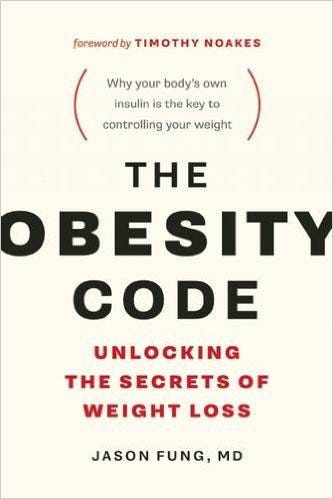
My book The Obesity Code lays out the science behind weight gain, and how to apply that knowledge to lose weight. It forms the theory behind the TFM program’s many successes over these many years. The book’s goal is to embrace these ideas and make it easier to implement in day-to-day life.
The key to long-lasting weight control is to control the main hormone responsible, which is insulin. Controlling insulin requires a change in our diet, which is composed of two factors — how high the insulin levels are after meals, and how long they persist. This boils down to two simple factors:
What we eat — which determines how high insulin spikes; and
When we eat — which determines how persistent insulin is.
Most diet plans concern themselves with only the first question, and therefore fail over the long term. It is not possible to address only half the problem and expect success.
In terms of the foods, this is not a low-calorie diet. This is not even necessarily a low carbohydrate diet. This is not a vegetarian diet. This is not a low-fat diet. This is not a carnivore diet. This is a diet designed to lower insulin levels because insulin is the physiologic trigger of fat storage. If you want to lower fat storage, you need to lower insulin, and this may be done even with a high carbohydrate diet.
Many traditional societies have eaten carbohydrate-based diets without suffering from rampant obesity. In the 1970s, before the obesity epidemic, the Irish were loving their potatoes. The Asians were loving their white rice. The French were loving their bread.
Even in America, let’s remember the 1970s. Disco was sweeping the nation. Star Wars and Jaws played to packed theatres. If you looked at an old photograph from that era, perhaps you might be amazed at several things. First, why did anybody ever think bell bottoms were cool? And second, it’s amazing just how little obesity there is. Take a look at some old high school yearbooks from the 1970s. There is virtually no obesity. Perhaps one child in a hundred.
What was the diet of the 1970s? They were eating white bread and jam. They were eating ice cream. They were eating Oreo cookies. There were not eating whole wheat pasta. They were not eating quinoa. They were not eating kale. They were not counting calories. They were not counting net carbs. They were not even really exercising much. These people were doing everything ‘wrong’ yet, seemingly effortlessly, there was no obesity. Why?
What about the diet of the Chinese in the 1980s? They were eating tons of white rice. On average, they were eating over 300 grams per day, compared to a low carb diet of fewer than 50 grams — and all highly refined. Yet they had virtually no obesity. Why?
What about the diet of the Okinawan? Over 80% carbohydrates, and mostly sweet potato, which has some sugar in it. What about the Irish in the 1970s, with their beloved beer and potatoes? They didn’t think twice about what they were eating, but until recently there was almost no obesity. Why?
The answer is simple. Come closer. Listen carefully.
They were not eating all the time.
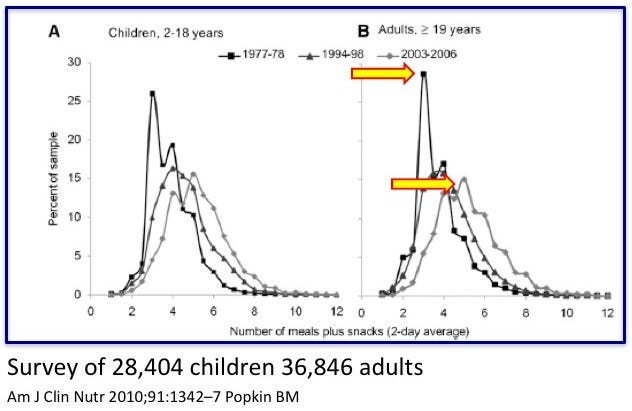
Surveys like the NHANES in America show that in the 1970s people were mostly eating 3 meals a day — breakfast, lunch and dinner. By 2004, people were eating closer to 5 to 6 times per day.
When you don’t eat, this is technically known as ‘fasting’. This is the reason there is the English word ‘Break fast’ or breakfast — the meal that breaks your fast. During your sleep, you are (presumably) not eating, and therefore fasting. This allows time for your body to digest the foods, process the nutrients, and burn the rest for energy to power your vital organs and muscles. In order to maintain a stable weight, you must balance feeding and fasting.
During feeding, you store food energy as body fat. During fasting, you burn body fat for energy. If you balance those two, your weight will remain stable. If you are predominantly feeding, you will gain weight. If you are predominantly fasting, you will lose weight. So, here’s my best single tip for weight loss. It’s so simple and obvious that even a 5-year-old could have come up with it.
Don’t eat all the time.
Unfortunately, most nutritional authorities will tell you the exact opposite. Eat 6 times a day. Eat lots of snacks. Eat before you go to bed. Eat, eat, eat — even to lose weight! It sounds pretty stupid, because it is pretty stupid. Instead, it may be better to use intermittent fasting, a dietary technique used successfully for countless generations.
Dr. Jason Fung

Online Fasting Community and Coaching
For more, check out my YouTube channel, online community and coaching programs at TheFastingMethod.com and my Website & Books
Dr. Fung,
I’ve read your books and followed intermittent fasting for several years, often doing 20-, 24-, and occasionally 72-hour fasts. During that period, I mainly did cardio, bootcamp classes, and bodyweight training, and fasting worked very well for me.
Recently, I transitioned to progressive overload resistance training. What I’m noticing is that fasting suddenly feels incompatible with the demands of the workouts. Recovery, performance, and hunger signals make it very difficult to maintain long fasting periods. Adequate food intake throughout the day, especially around workouts, seems necessary.
It made me wonder whether the metabolic demands of progressive overload fundamentally change the equation.
Would you consider writing about how progressive overload and hypertrophy training interact with intermittent fasting? Specifically:
• Does progressive overload increase the need for more frequent protein intake?
• At what point does fasting begin to compromise recovery or muscle growth?
• Is fasting still appropriate for people training for hypertrophy rather than fat loss?
Many people who follow your work are transitioning from metabolic health goals into strength training, especially those of us in our 50s who want to maintain bone density, and I think this topic would be extremely helpful.
Thank you for your work and your writing.
One of your greatest longtime fans,
Conchita
I appreciate your writings and perspective. I think there are a few other factors at play though, that I’d love to see you explore. Seed oils are a big one I think, as well as environmental toxins. Definitely true that people are eating way more often and I know that’s important, just maybe not the whole picture.