The Diet Wars
Diets always work differently for everybody

The Diet Wars — to see whose cuisine reigns supreme — has been going on for some time. The incumbent, and increasingly looking-really-old-fashioned Low Fat diet has been recommended for many decades by most health professionals. It made its first appearance in the late 1970’s based on its supposed benefit for reducing heart disease. Dietary fat will clog your arteries! was the battle cry. Health professionals like doctors rallied behind the great Empire of Low Fat. But in a galaxy far, far away, a small rebel band was forming to challenge this dietary orthodoxy, and embraced natural fats believing instead the culprit was sugar and refined grains.

The Empire put its prodigious resources into a massive ‘Death Star’ study that would prove the Low Fat paradigm for once and for all. Once this was completed, they believed, it could blast any rebel strongholds at will. The resulting Women’s Health Initiative (WHI), recruited close to 50,000 women into a ginormous randomized controlledtraillasting over 8 years. Women were randomly assigned to their usual diet group or a low fat diet. After 8.1 years, researchers would find, lo and behold, that these Low-Fat women would have less heart disease, less obesity, and less cancer. Ummm. Right. That’s exactly what DIDN’T happen.
Published in 2006, the WHI showed that following the low fat diet for 8 years, compared to eating the usual diet,did NOT reduce heart disease. It did NOT reduce colo-rectal cancer. It did NOT reduce breast cancer. Despite reducing calories, it did NOT reduce weight either. That massive ‘Death Star’ study? Yeah, it just got blown to pieces. The Low Fat dogma took a beating, but the Low Fat Empire, with its calorie restriction still limped on, trying to become the First Order.
Many of the formerly ‘crazy’ beliefs of the rebel band have been accepted into dietary orthodoxy. For example, few people believe that eating white bread, pasta, or sugar is all that slimming. High fat foods like olive oil, avocados, fatty fish and nuts which were shunned years ago, are now often called ‘healthy fat’ foods. Years ago, the term ‘healthy fat’ did not exist, because it was ‘well known’ that all dietary fats would kill you.
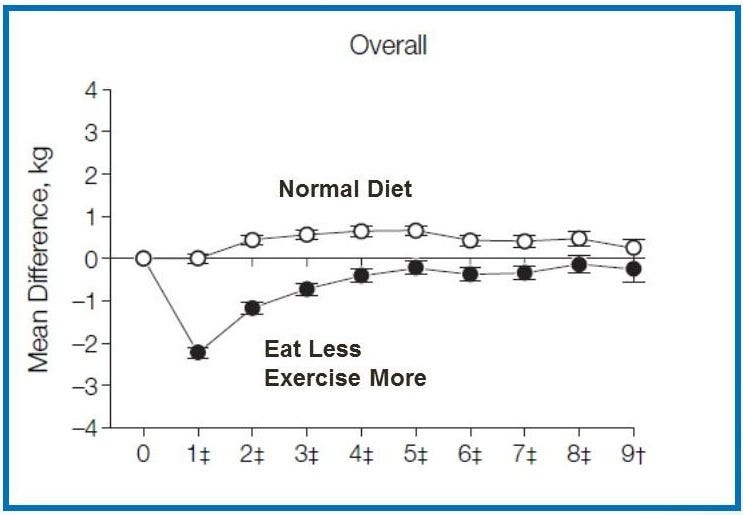
The bloodiest battleground in The Diet Wars is the ‘A calorie is a calorie’ contention that it alone is the major cause of obesity and hormonal factors, like insulin are largely irrelevant. But it’s a trap. No weight loss diet fails quite so spectacularly as the caloric restriction diet.

There is, of course, an overlap between the insulin stimulating effect of food and the caloric value. Some foods increase insulin more than others. That simply implies that some foods are more fattening than others, even if exactly the same number of calories. This is just pure common sense and exactly what your grandmother would have told you, after chastising you for having no brains. Except for academic obesity specialists and researchers, who is foolish enough to think that 100 calories of brownies is equally fattening as 100 calories of kale salad?
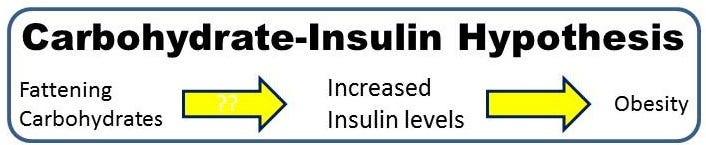
Insulin is one of the main drivers of obesity, leading to the Carbohydrate Insulin Hypothesis (CIH). This holds that dietary carbohydrates are the main or only cause of increased insulin, and thus reducing carbohydrate intake is necessary to lose weight. However, the CIH is incomplete, because there are many, many different influences upon insulin levels other than carbohydrates, including meal timing (eating late at night releases more insulin, incretins, vinegar, fibre all reduce insulin, insulin resistance and fructose directly increase insulin etc). This leads to a far more complete theory of obesity that takes all these factors into account instead of merely the carbohydrate or calorie content of foods.
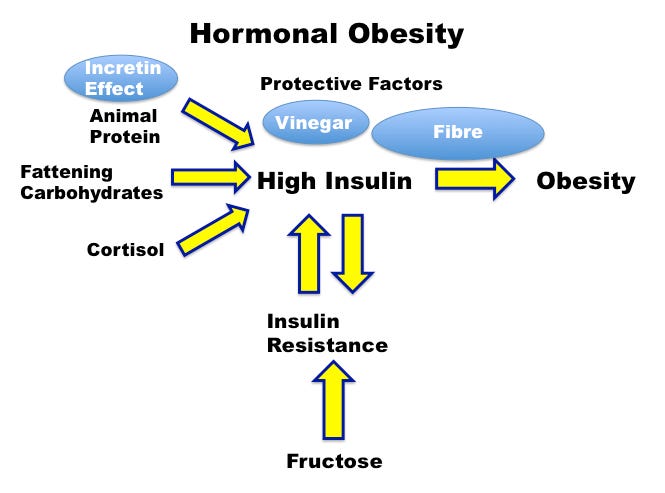
With that background, I suggested in The Obesity Codethat the main steps to reducing obesity are:
Reduce your consumption of added sugars.
Reduced your consumption of refined grains.
Moderate your protein intake.
Increase your consumption of natural fats.
Increase your consumption of fiber and vinegar.
But above all else my main advice is to eat unprocessed real food. Processed grains are not good, but neither is processed fats such as seed oils or processed red meats.
When you eat real food, you activate natural satiety mechanisms — cholecystokinin, peptide YY, stretch receptors in the stomach, incretins etc. that signal us to stop eating. But this applies to both low fat and low carbohydrate foods. When you eat processed grains (donuts) you don’t get full. When you eat unprocessed carbs (beans) you do. Thus you stop eating because you are not hungry at a level that is far below the previous caloric intake (roughly 500 calories/day). But it did not require calorie counting to achieve this. It requires cutting out all processed foods.
Diets don’t work the same in everybody
The same diet can work differently for different people. Consider this study of Low Fat vs Low Carb diets. MOST people did better with low carb, but there is a huge discrepancy. Some people lost 25kg on it and others gained 10kg. ON THE SAME DIET.
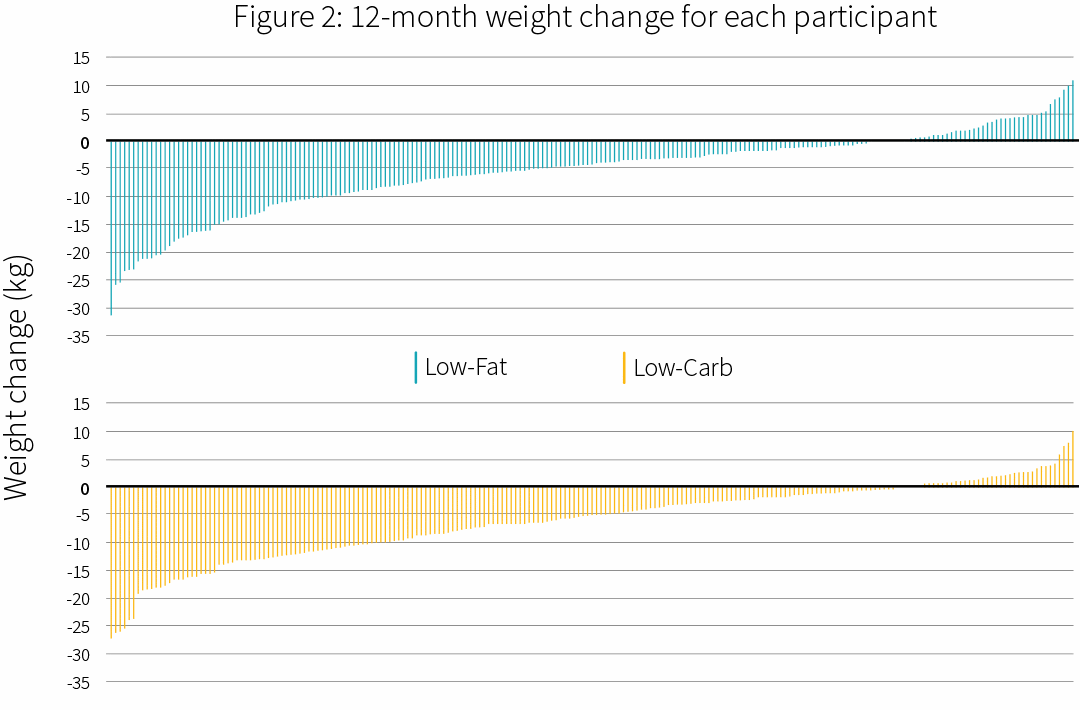
There was also some huge differences between people in the same diet. In both groups, some people lost 25 kg (over 50 pounds) and some gained 10 pounds. ON THE SAME DIET! Do what works for you.
Don’t be dogmatic about diets. If you follow a low fat diet and lose weight, great. The only logical thing is to keep doing it. BUT. If it does not work, then change it and see if it works better. The general rules are all the same — avoid highly processed foods, avoid added sugar, avoid refined grains, but you can tweak endlessly around the edges. The only thing that really matters to us is that you get results. Look, we are all individuals. I am good at medical physiology and suck at basketball. LeBron James is good at basketball and probably sucks at medical physiology. I make a living doing what I do, and he makes a living doing what he does. So why force one dietary approach to fit all?
So, why do I usually recommend a Low Carb diet? For several reasons. First, most carbs in Western society are refined grains. So Low Carb is a useful short hand for reducing sugar and refined grains.
I don’t tell people what they ‘must’ eat. There is no such thing. See what you eat, and see if you get the results you are looking for. If it works, great. If it doesn’t work, then change.
Dr. Jason Fung

Online Fasting Community and Coaching
For more, check out my YouTube channel, online community and coaching programs at TheFastingMethod.com and my Website & Books
Keto which is high fat low carb worked well for me for a short while and then I crashed hard.
I later learned that if you consume too much fat and protein, your body shifts out of a more efficient cycle to use the fat more effectively, as if you were on permanent fast.
It's all about balance .. I hear keeping fat calories below 25% of total calories prevents issues.
https://haidut.me/?p=2710
https://haidut.me/?p=1994
https://haidut.me/?s=Fat
I appreciate your analysis & the Star Wars comparisons. I am currently working on an organic, whole food approach to my cooking & diet. I would love to lose weight, but my goal is to have a healthy diet, exercise and proper sleep. If I lose weight, great. If not, I’m still doing the right things to age gracefully at 69.