Insulin Vs. Calories —Which controls the Body Fat Thermostat?
I’ve read hundreds of weight loss studies and this is one of my favorites. Controlling the Body Fat Thermostat — Part 9


There is a saying — ‘a calorie is a calorie’. This usually implies that all calories are equally fattening.
It’s sneaky to say this because obviously a calorie is a calorie, just as a dog is a dog, but it is not at all obvious that all calories are equally fattening. 100 calories of cookies and 100 calories of broccoli have the same calories. Are they therefore equally fattening? The fact that the cookies will stimulate completely different hormones than the broccoli is considered irrelevant.
Suppose you eat 100 calories of cookies vs 100 calories of broccoli.
Are the hormonal responses completely different? Yes. This is a well-established fact.
Do different hormones affect body fat differently? Yes. This is a well-established fact.
Therefore — why would anybody with even a tiny brain think that all calories are equally fattening?
What confuses the issue is that there is a major overlap between calories, which is the physical energy contained within a food, and insulin, which is a hormone stimulated by eating certain food. This is not a 1 to 1 correlation in that some foods will have a robust insulin response (eg. white bread) where others (eg. butter) has a minimal insulin response.
All foods are composed of varying proportions of the three macronutrients — fat, protein and carbohydrates. Many factors, including what proportion each of those macros contribute to the insulin effect of foods. But for any given food, with mixed assortment of carbs, proteins and fats, the more you eat, the more the insulin response.
If insulin is one of the main hormones that causes increased weight (see It’s the Insulin, Stupid), then this is the only implication:
Some foods are more fattening than other foods.
That doesn’t seem that controversial. Cookies are more fattening than broccoli. Candy is more fattening than eggs. Cake is more fattening than salmon. Seems pretty much like common sense. Seems like something everybody’s grandmother knew instinctively. But it’s heresy to some people who continually insist that ‘a calorie is a calorie’.
Calories and insulin are different (one is a measure of energy and the other is a hormone) and interdependent. They number of calories influences your hormones (eg. eating two cookies stimulates more insulin than 1 cookie). The hormonal balance will influence how many calories you eat (by hunger for example).
Both are factors, but which one is more important for weight gain?
Calories and Thermodynamics
Calories measure the energy contained within an object when burned in a bomb calorimeter. For example, you can measure the energy contained within a piece of wood and ice cream. Calories are calories, right?
Take 100 calories of wood and 100 calories of ice cream. Burn them in a fire. Are they the same? The wood lights up and generates more heat. The ice cream melts and soaks up heat. Since calories are calories, shouldn’t the fire react the same to putting wood in as putting ice cream? Isn’t this following the ‘first law of thermodynamics’?
Obviously the fire reacts differently. There is a lot more to the issue than just energy, or ‘calories’. The important part is how the fire reacts to the wood versus the ice cream, not just the energy of what you put into the fire.
Now think about 100 calories of cookies versus 100 calories of broccoli. The cookies stimulate insulin which tells our body to store that energy as body fat. The broccoli does not stimulate much insulin, so our body uses those 100 calories for generating body heat.
This does not break any laws of thermodynamics but has huge implications for how much body fat we carry.
It’s not the calories that are important, it’s how our body responds to those calories. Those instructions to the body about how to use those calories are transmitted via hormones.
I spent 2 years in university studying biochemistry and thermodynamics was a huge part of my studies. ‘Calories’ is simply not a term used in the study of thermodynamics. That is, people who study thermodynamics (physicists) never discuss calories. But the calories people always somehow bring up thermodynamics, in a desperate attempt to appear scientific and cool and inevitable. It’s pure physics envy.
Thermodynamics applies to the whole universe, including the human body. Consider the Energy Balance Equation:

Absolutely true. But this doesn’t mean that reducing ‘calories in’ causes body fat to decrease. There are 3 variables here that must balance. If you reduce calories by 500 calories and burn 500 fewer calories, then body fat remains stable.
If you increase exercise (calories Out) by 500 calories, but reduce basal metabolism by 500 calories, then body fat does not decrease.
If you increase calories out by 500 calories and increase calories in by 500 calories, then body fat will not decrease.
All of these scenarios follow the laws of thermodynamics, yet still do not shed any light on how to lose weight. Accepting that hormones play a role in body fat does not mean that we do not accept the laws of thermodynamics.
Calories and Human Physiology
Insulin is a hormone that tells our body to store calories.
A calorie is a calorie. (True).
All calories have different effects on hormones. (True)
Hormones have different effects on body fat percentage. (True)
So all calories are not equally fattening. Eating 100 calories of candy is more likely to make you fat compared to 100 calories of broccoli. Duh. Who ever thought different? That’s just common sense.
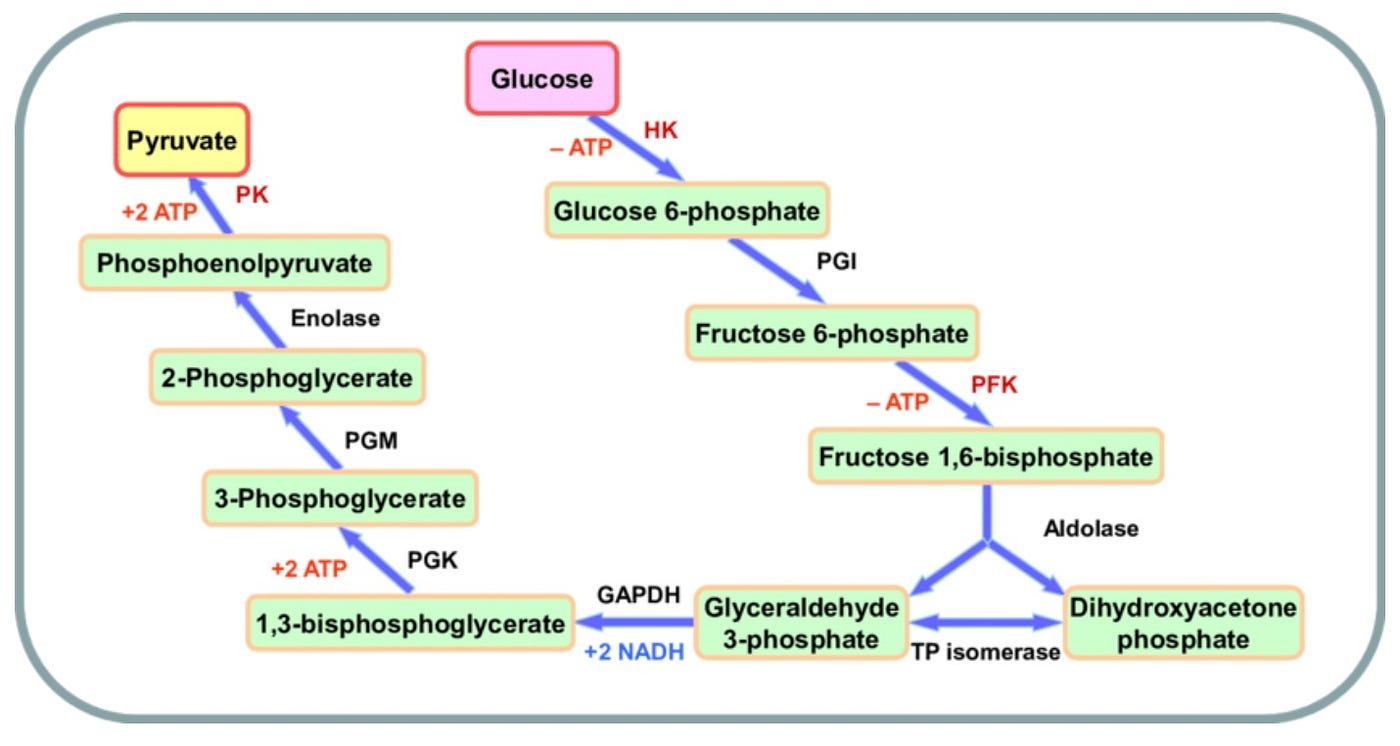
Human physiology does not care about calories. Your body uses energy — transforming energy as glucose, or fat or protein into a cellular form such as ATP. Our body does not burn ‘calories’. Look at any standard textbook of physiology and the metabolic pathways. There is no mention of ‘calories’. Here’s the metabolic pathway for glycolysis (burning glucose for energy). Yes, there is glucose. No, there is no ‘calories’.
Here is the metabolic pathway for fatty acid oxidation. Yes there is fat (triglyceride). There are many intermediaries. No, there is no ‘calories’.
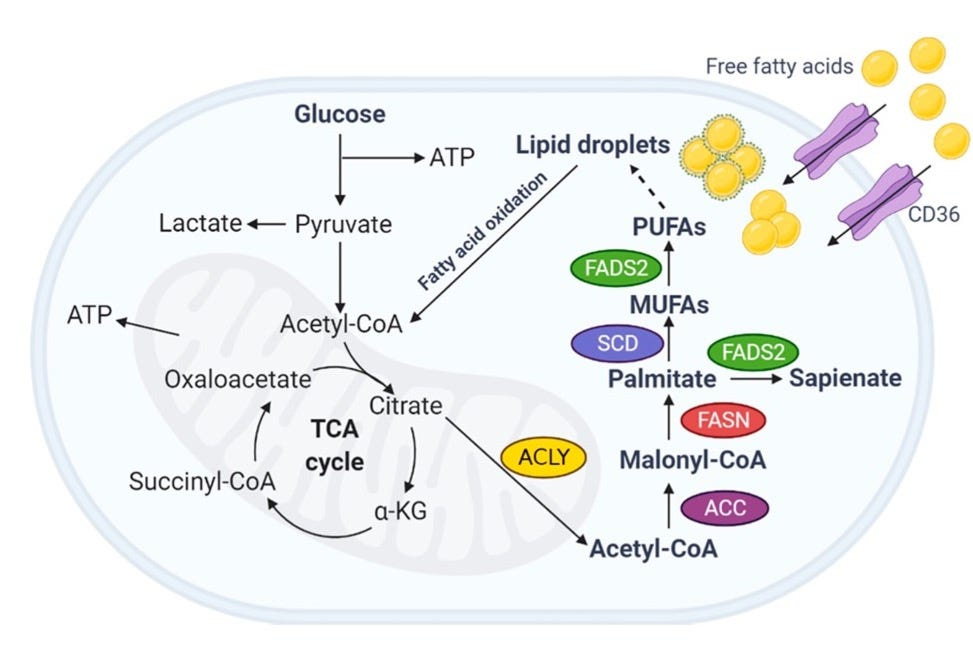
The reason why ‘calories’ is never mentioned is that it is not a physiologic term. Calories from carbs (glucose) are metabolized in a certain way. Calories from fats are metabolized in a certain different way. They are wildly different, so why pretend that they are the same? Wood is not the same as ice cream for your fire. Wood is not the same as ice cream for your body either, even if they have the same energy (caloric) content.
Why the hell do we pretend that all calories are identical, even when it is bloody obvious that they are not? But which is more important?
Insulin Versus Calories
There are two competing views of human obesity.
1. Obesity is an excessive insulin problem — the hormonal view. Insulin tells us to gain weight. Higher levels of insulin cause us to gain more weight.
2. Obesity is an excessive calorie problem — the calorie centric view. If you eat more calories, you gain weight. If you eat less calories you lose weight.
What if we give people insulin and at the same time restrict their calories? Will their body gain weight or lose weight?
If insulin is the primary factor, then people should gain weight.
If calories is the primary factor, then people should lose weight.
So here’s the study that pits them head to head, like two prize fighters.

Researchers looked at patients with type 2 diabetes, who were initially not on insulin. They were given insulin at a very aggressive pace — which was fairly standard in the 1990s, when this study was done.
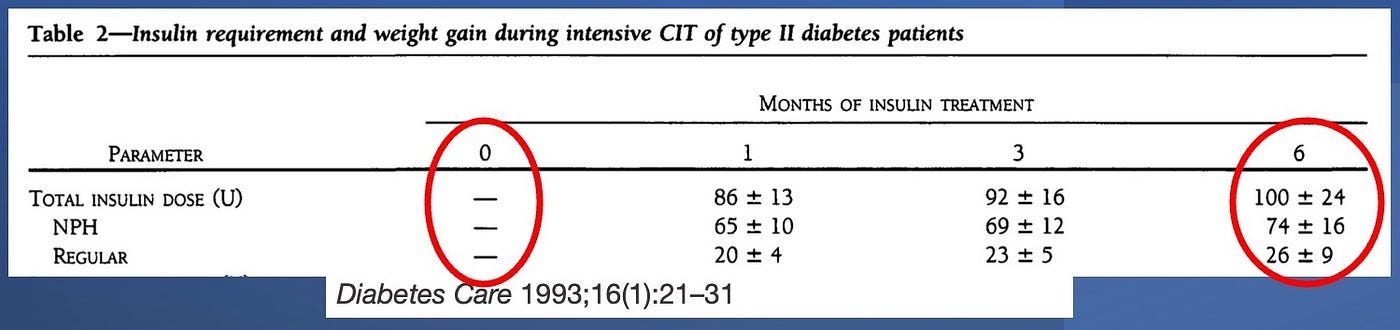
Insulin increased from zero to 100 units per day.
By the end of 6 months, people were taking an average of 100 units of insulin, split between long and short acting types. 100 units of insulin is a massive amount of insulin.
At the same time, people also reduced their calorie intake, from 2023 calories per day to 1711, which is 312 calories per day fewer. Over 6 months, if 1 pound of fat is about 3500 calories, we should expect a weight loss of 16 pounds, if insulin is just not that important, as the calorie aficionados keep harping about.
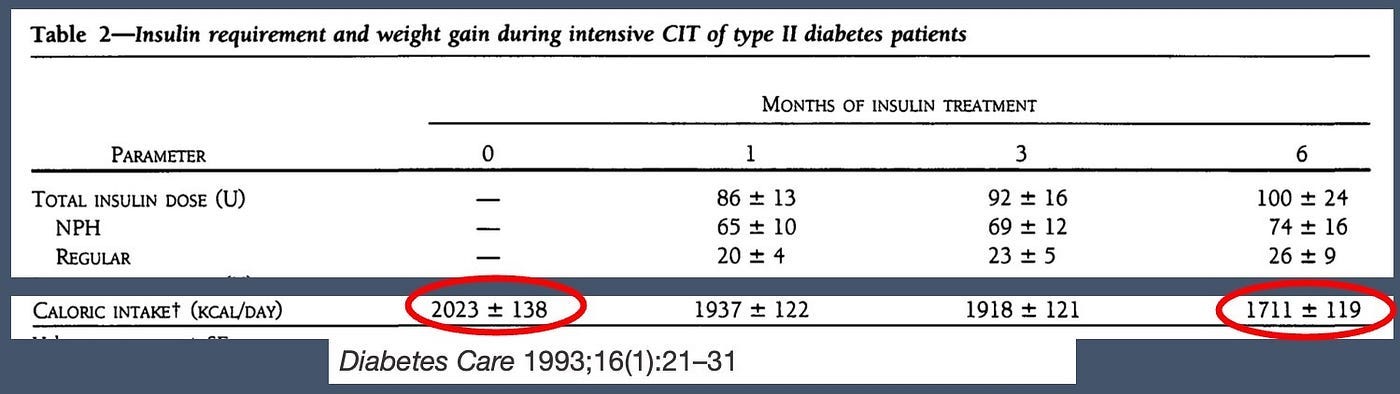
So now we have two competing effect — insulin will tend to make people gain weight, and reducing calories will tend to make people lose weight. Which effect is the most prominent?
Which is more powerful — Insulin Or Calories?
It wasn’t even close.
On average, people who took more insulin but less calories gained 8.7kg (19.1 pounds) over 6 months.
That’s insane. Eating 300 calories less per day they should have lost 16 pounds but instead gained 19 pounds. That’s a pretty big fucking miss for the Calories are Calories argument — a difference of 35 pounds.
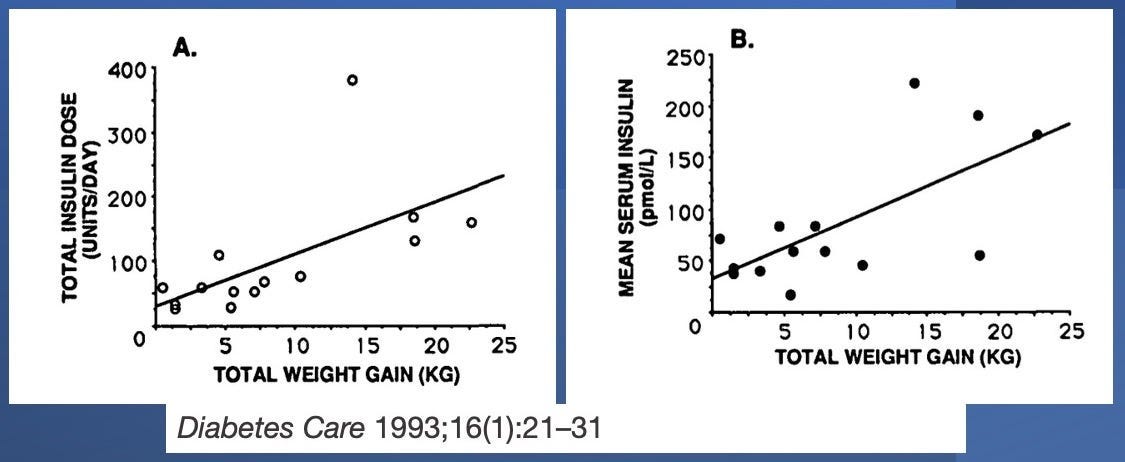
More insulin = More weight gain
There’s a very tight correlation between how much insulin was given, much high the insulin level in the blood became, and how much weight was gained.
Insulin and Insulin Resistance
What’s also interesting is what happens to the insulin resistance. In type 2 diabetes, insulin levels are already too high. So what happens when you give more insulin?
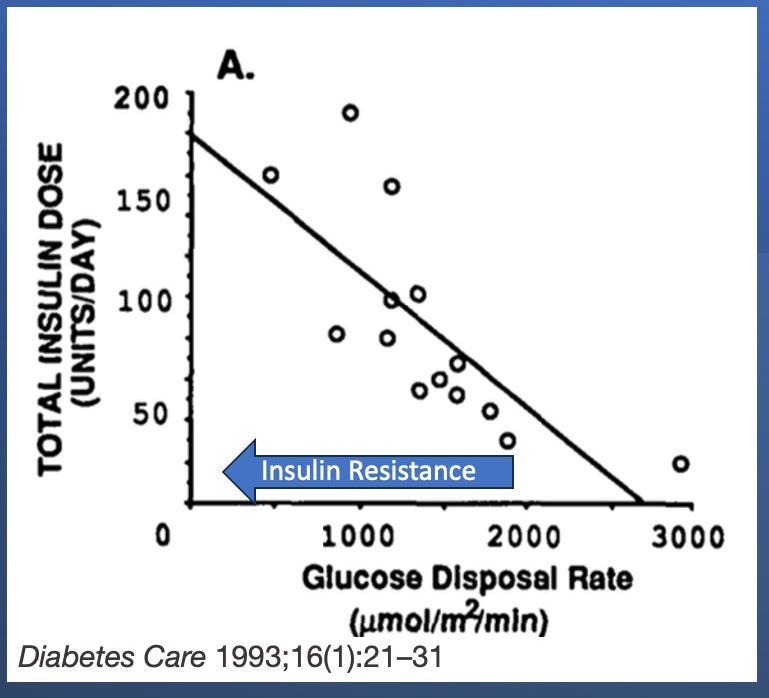
More Insulin = More Insulin Resistance
The glucose disposal rate is a way to measure insulin resistance — the higher the insulin dose, the higher the insulin resistance — that is the worse the diabetes was getting. Giving insulin to a person whose insulin levels are already too high made things worse, not better. Who knew? Everybody except the doctors.
If you had type 2 diabetes and were overweight and got lots of insulin, you gained weight. As you gained weight, your diabetes got worse. This meant you needed more insulin. Which caused more weight gain. Which made diabetes worse. Which meant you needed more insulin.
The solution was the exact opposite. If your insulin levels were too high, you needed to reduce insulin.
Insulin causes weight gain.
All of which leads to the inescapable conclusion that insulin causes weight gain.
But yes, there is an overlap between calories and insulin. Reducing calories can reduce insulin, but some calories raise insulin more than others. If you want to maximize weight loss, you should eat less of those foods that stimulate insulin a lot. Or put another way, eat 100 calories of broccoli, not 100 calories of cookies. They’re nothing the same. A calorie is not a calorie. But of course, you already knew that eating broccoli is better than eating cookies. Only an idiot who has never had to get people to lose weight would think that those 100 calories are the same. They’re not. And your health and weight depend on you knowing this.
A Calorie is a Calorie, but not all calories are equally fattening.

For more, check out my YouTube channel, online community and coaching programs at TheFastingMethod.com and my books
This was a helpful reminder that body weight isn't just about energy in versus energy out, it's also about the hormonal signals that determine what the body does with that energy. The biology is clearly more nuanced than calories alone.
I may be missing something as I only have access to the abstract. But, to build the insulin hypothesis and the thrust of the article based upon 14 patients and no control group seems like a bridge too far from an evidentiary standpoint. The theory of insulin is the problem makes cool mechanistic sense. I don't see the human RCTs to support that calories don't matter in this story....I have various posts about how and why we get excited about cool theories but w/o rigorous clinical evidence, I will remain an "open-minded" skeptic on this topic.