Exercise for Weight Loss? It’s pretty Meh. Here’s why.
The Body Fat Thermostat Part 7


Exercise is definitely good for you, but completely overrated for weight loss.
Body fat is regulated like a thermostat (see the Body Fat Thermostat series — start with part 1). So, what causes us to store more body fat than in previous generations? Is it calories? No, as we explored in our last article — The Overfeeding Paradox.
Perhaps the thermostat is racheted up by a lack of exercise and increasing exercise is a way to lower our Body Set Weight.
There’s a persistent belief that obesity is caused by lack of exercise. We’ve all heard this before. People are so much less active than before and this is what contributes to the obesity epidemic. Sounds plausible. Lots of ‘experts’ repeat this ad nauseum. The problem is lack of exercise, so you just need to exercise more to lose weight. To lose weight, more exercise is the key.
Sounds convincing. Too bad it’s completely wrong.
We exercise more, yet weigh more
The study “Total Daily Energy Expenditure has declined over the last 3 decades due to declining basal expenditure not reduced activity expenditure” sheds some light upon the question of exercise. The total amount of calories burned in a day is also called Total Daily Energy Expenditure (TDEE) or Total Energy Expenditure (TEE).

TEE is composed primarily of two things. First, the metabolic rate or Basal Energy Expenditure (BEE), which is the energy used in generating body heat, keeping our hearts pumping, our lungs, liver, kidneys, brain working etc. The other major component of the calories we use is exercise — which is also called Active Energy Expenditure (AEE). There are some minor components like non exercise activity thermogenesis (NEAT) and the energy used for digestion of food — thermic effect of food (TEF), but they are small contributors, so we’ll ignore them for now.
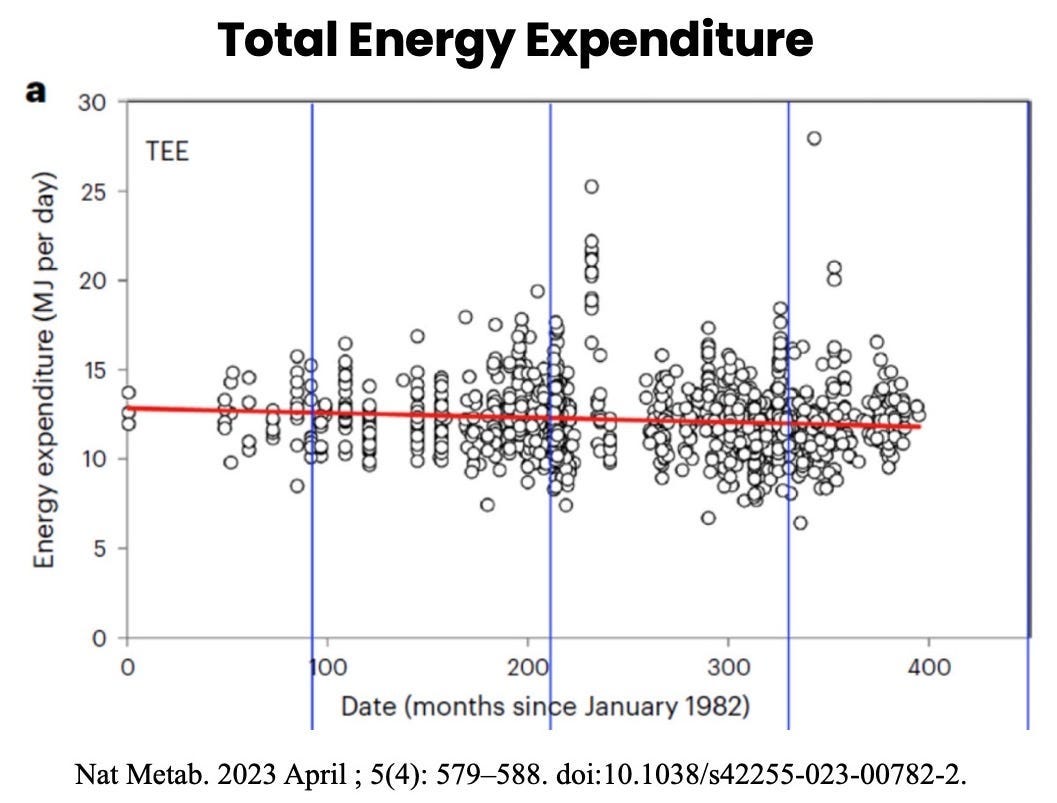
Total Daily Energy Expenditure declining since 1982
Since 1982 (before much of the obesity epidemic), TDEE decreased steadily over time. In males, TDEE decreased about 7.7% over 30 years, and in females this figure was 5.6%. Ah Hah! People are burning fewer calories and therefore storing more fat. It must be the lack of exercise, right? Get off your lazy ass, right?
Totally wrong.
In fact, the calories expended doing exercise has increased steadily over the last 30 years.
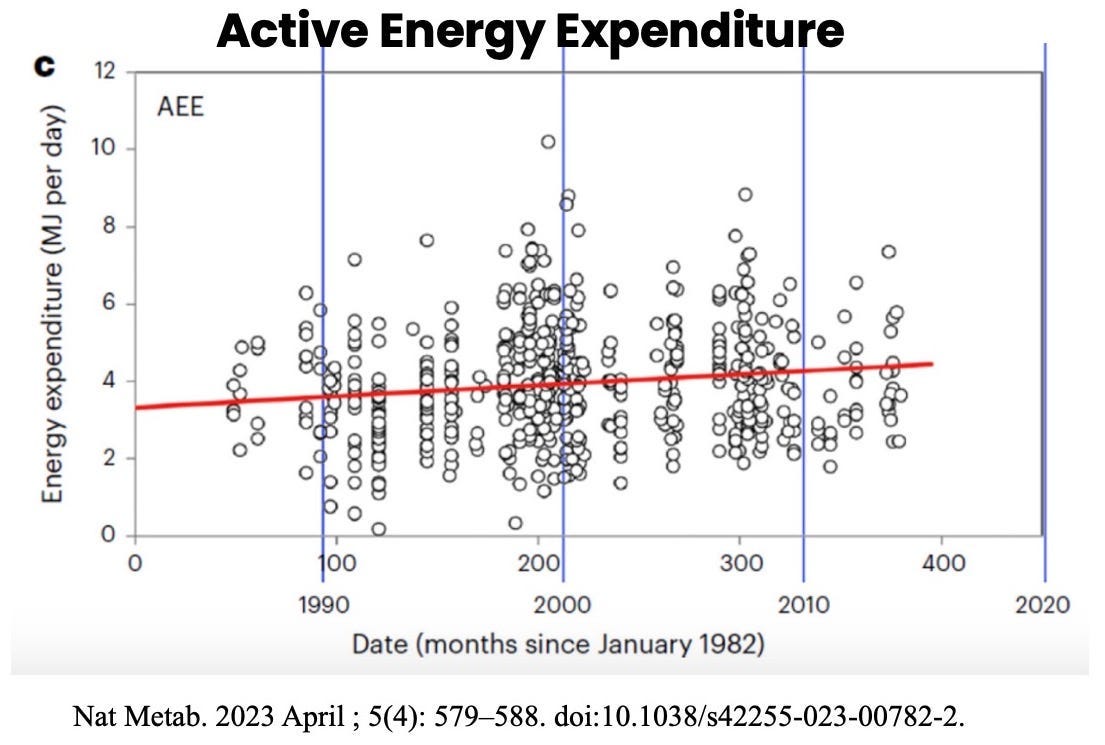
Exercise has increased since 1982
We are exercising more than we did in 1982 even as obesity has become a national epidemic affecting every population in the world.
The decline in TDEE was largely driven by the decrease in BEE over time. This is not something that people can control. You can’t decide how much heat your body generates. You can’t decide how much energy your brain, heart, kidneys or lungs use. It is not due to lack of willpower, or something you ate or something you did or didn’t do.
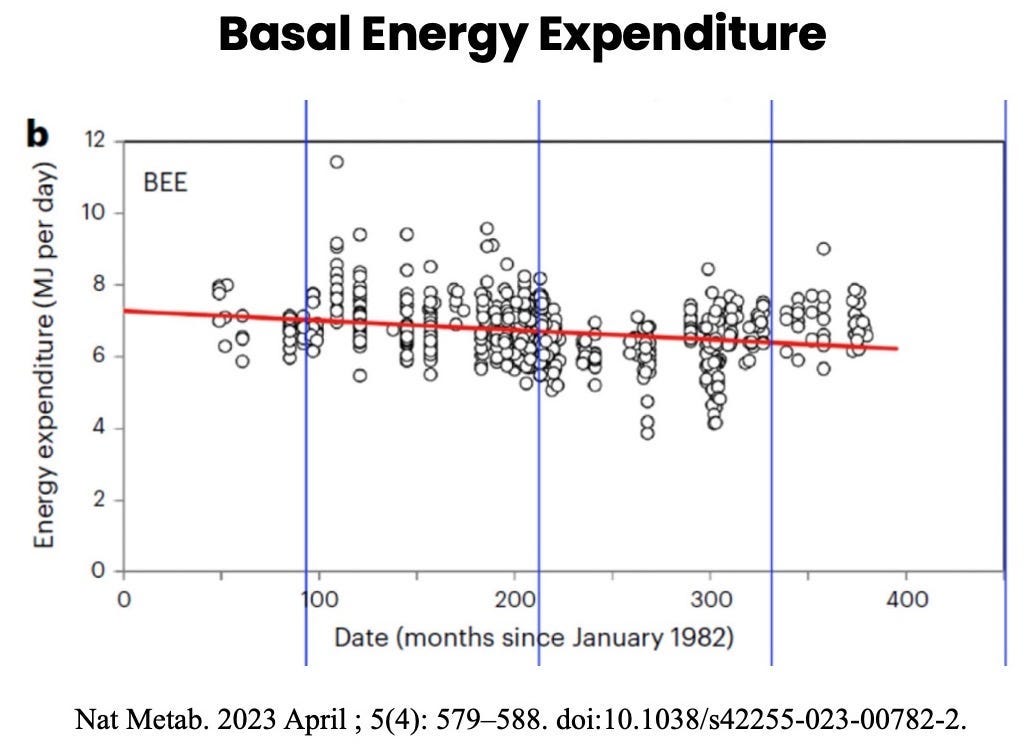
Metabolic rate dropping since 1982
And if we look back over the past century, we see that Basal Metabolic Rate (BMR) has been slowly decreasing since the 1920s.
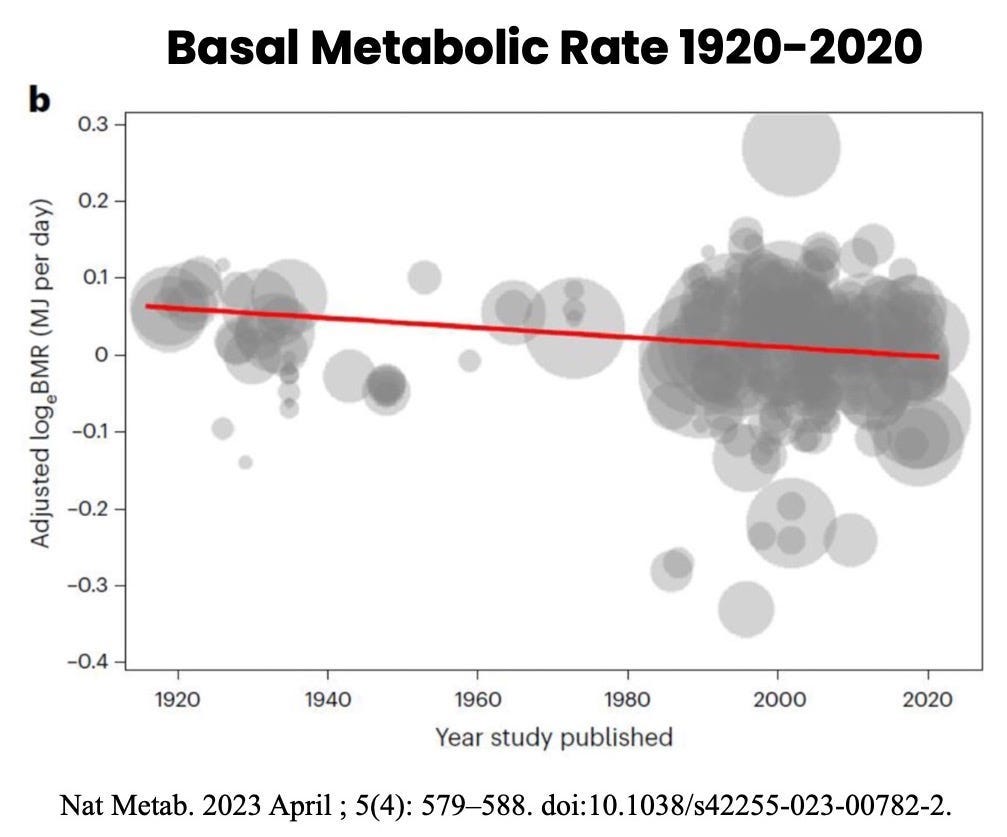
Metabolic Rate dropping since 1920s
This decreased metabolic rate is reflected in the decreasing body temperature in adults in the United States over time. In the paper, “Decreasing Human Body Temperature in the United States since the Industrial Revolution”, researchers found that the average body temperature has been slowly decreasing. If you are burning fewer calories, you’ll generate less body heat, which shows up as a lower body temperature.
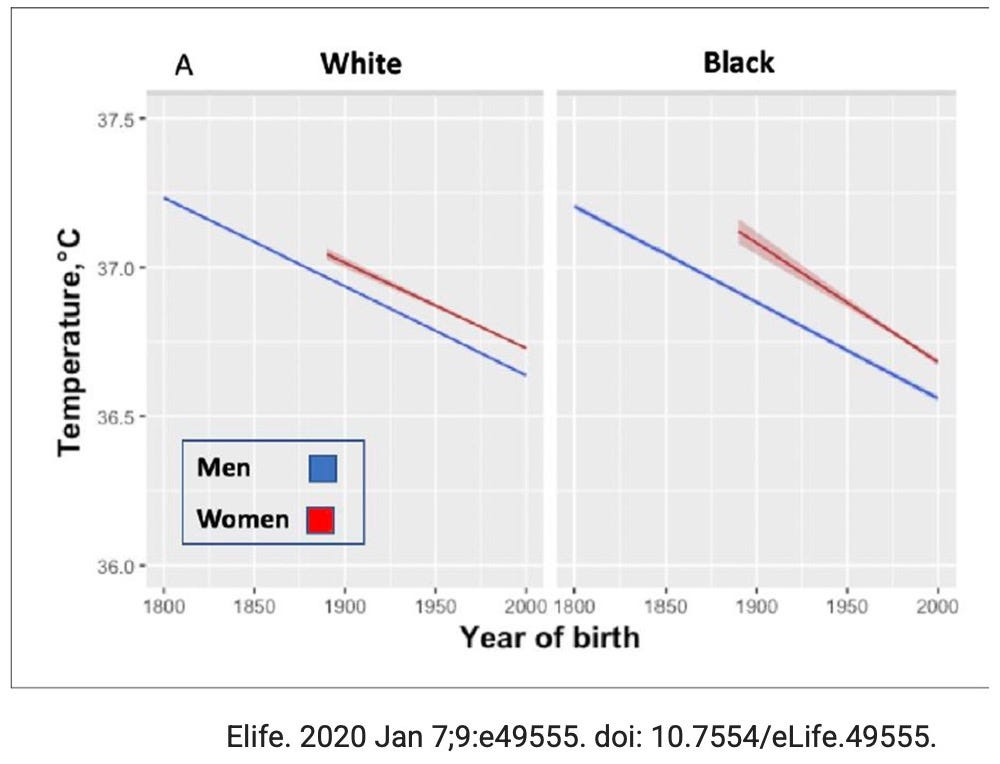
Body Temperature dropping since 1820s
High Exercise decreases Metabolic Rate
Exercise increases calories burned during exercise, which most people assume will increase total calories burned according to the previous equation:
This is known as the Additive Model. Suppose that you burn (basal metabolic rate) 1800 calories per day and exercise burns another 200 calories. The TDEE is 1800 + 200 = 2000 calories per day. If you increase exercise to 1000 calories per day, your TDEE is 1800 + 1000 = 2800. This assumes that increased exercise does not affect metabolic rate.
This is not completely true especially for high levels of exercise.
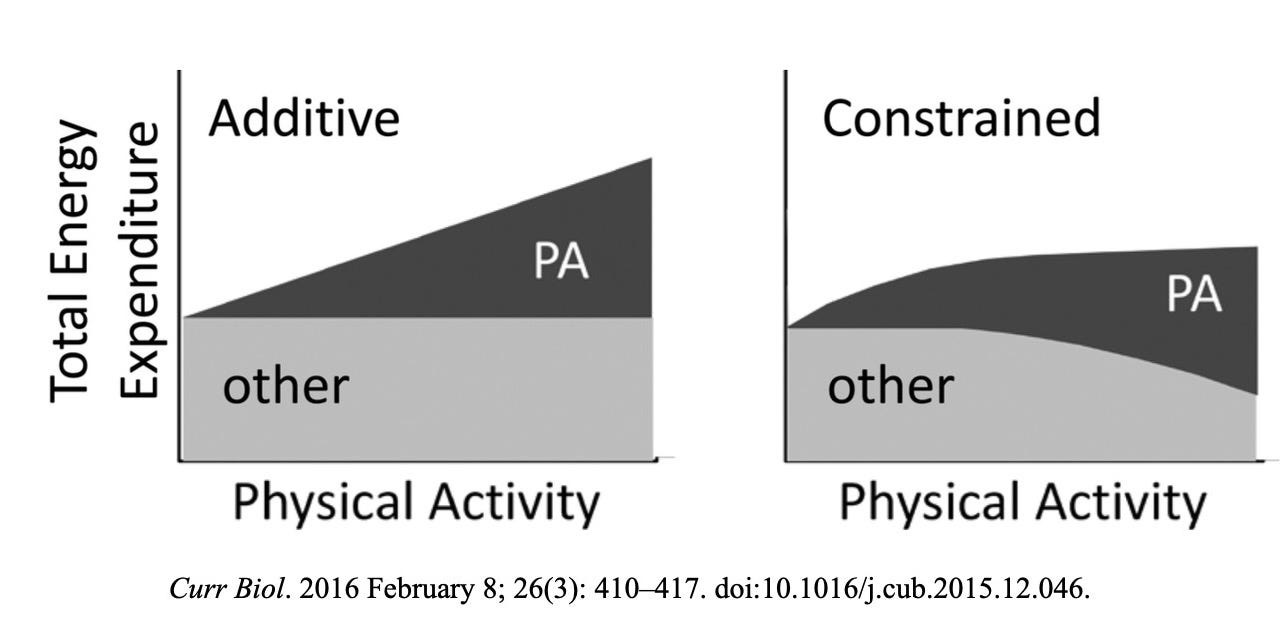
Additive vs Constrained Model of Physical Activity
The Constrained model theorizes that as you exercise more, your body keeps the total calories burned stable by decreasing your metabolic rate. This conserves precious energy which will allow you to survive longer. That is, higher levels of exercise slowing metabolism.
Which model is correct? Unfortunately for us, it is the constrained model.
In the research article “Constrained Total Energy Expenditure and Metablic Adaptation to Physical Activity in Adult Humans”, TDEE was measured in response to increasing levels of exercise. Rather than TDEE increasing linearly as predicted by the Additive Model, when people increase their exercise, they quickly reach a point where further exercise does not increase total calories burned.
The basal metabolic rate decreases quickly to match the increase in calories used by exercise. Mild to moderate exercise does increase TEE, but further increases past that are met with drops in metabolic rate.
Then you see that as you increase exercise past mild-moderate, your basal metabolism falls and the TEE stays stable. So if you look at the ‘Calories Out’ part of the energy balance equation, if becomes difficult to increase ‘calories out’ simply by increasing exercise.
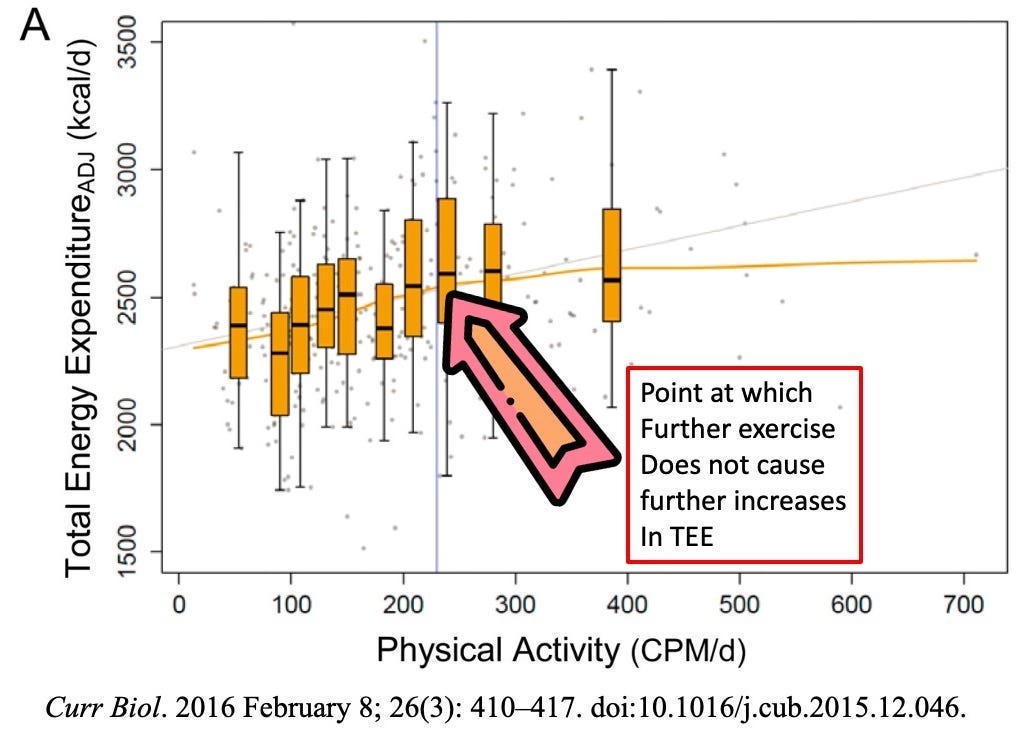
Oy vey! Increased exercise, beyond a mild-moderate amount, does NOT increase total calories burned. Therefore, it contributes little to increased weight loss.
Oh, but the news gets worse.
Exercise increases Hunger
So, exercise has been slowly increasing over the past few decades, which just offsets the decreased basal metabolic rate. It can still be an effective weight loss aid, right? Yes and no.
Remember the energy balance equation:

Energy Balance Equation
Exercise presumably increases calories burned (although this is only true for mild — moderate, not intense exercise), and this will decrease body fat if and only if the amount we eat stays the same. But if exercise increases hunger, that will naturally lead us to eat more, which will largely negate the benefits of that exercise for weight loss.
In 2021, a meta analysis was done looked at this very question — does exercise increase hunger? The answer, unfortunately for us, is yes.
During the exercise itself, hunger decreases. That makes sense. Imagine you are in a competitive game of basketball. As you focus on getting around your defender to score the game winning basket, do you ever suddenly think, oh boy, I’m kind of hungry? A little peckish. Could use a little snack just about now. Obviously not. But what about after the acute exercise? That’s what is really important.
There were 19 studies deemed good enough to include in the meta-analysis. When considered together, there is a small but significant increase in hunger with exercise. This, too makes perfect sense.
I remember many times that I would spend a morning or afternoon playing sports or cycling or roller blading and eat ravenously afterwards. It was pretty obvious that the exercise had increased our hunger. They don’t call it ‘working up an appetite’ for no reason, you know.
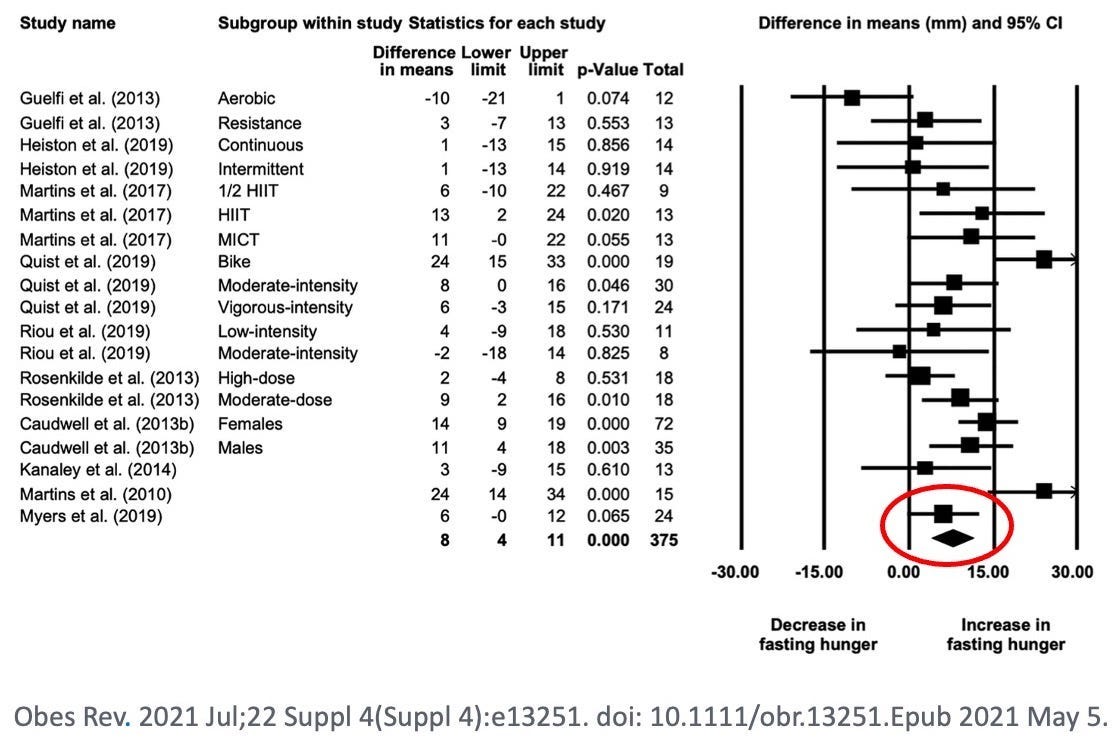
The main implication is that yes, you can exercise more, but then you’ll be hungrier which will naturally lead you to eat more, negating a lot of the weight loss benefits.
Why Exercise is pretty Meh for weight loss
1. Basal metabolic rate has been falling steadily since the Industrial Age. The reasons why this has occurred are unknown, but are not from lack of willpower or lack of exercise.
2. Calories burned from exercise have been increasing since the 1980s and therefore lack of exercise is likely a small or non-existent contributor to the obesity epidemic.
3. Moderate to intense exercise decreases metabolic rate so total energy expenditure stays the same and negates much of the benefits of weight loss. Mild exercise just doesn’t burn much calories.
4. Increasing exercise increases hunger, which leads to eating more, and negating much of the benefits for weight loss.
No, the solution for adjusting the body fat thermostat is not just increased exercise.

For more, check out my YouTube channel, online community and coaching programs at TheFastingMethod.com and my books
I wonder whether the metabolic rate was higher before antibiotics, vaccines and parasitology because people were more likely to carry a load of “passengers” in and on their bodies. Chronic, low-level infections or infestations would make the body run hotter, no?
That's why softer and shorter exercise like qi gong is preferred.
I do 7 minutes a day, sometimes with wrist and leg weights. I feel stronger and my cognition has improved much faster than when I did aerobics or extended weights.
Most of the muscle building and brain benefits come from minutes a day without burning up calories. Now I see why.
BTW, the reason why mild exercise helps memory and cognition is because the cerebellum is what stores memory and later translates it to long term storage. It operates on physical movement.