Conquer Food Cravings
Treat it like an addiction, not a suggestion

Food cravings are defined as frequent intense urges to eat specific types of food.There are people who deny their existence, but in truth, we’ve all felt them, some more than others. For example, some people have intense food cravings for sugar (probably the most common). However, salty foods, chocolate, and junk food (like pizza) are also common food cravings.

We may know very well from an intellectual standpoint thateating these foods will make us gain weight,but we feel helpless to resist. This is not really all that hard to understand. Consider a substance such as alcohol. Even as drinking destroys his life, the alcoholic feels compelled to drink. We understand that he is the victim of alcoholism and provide support to him to reverse it. For example, he might be encouraged to join Alcoholics Anonymous, without stigma that he ‘let himself go’ or that he simply had no willpower.
Unfortunately, food cravings are not free of such stigma. If you are unable to resist the call of the donut, then many people consider it your fault, and help is much harder to find.
There’s an association between obesity and food cravings, and the same holds for type 2 diabetes. The most consistent offenders are sweet foods, starchy foods, high fat foods, and junk foods. But does food craving lead to obesity, or does obesity lead to food cravings, or both? This is a very important question, because understanding the cause (etiology) is the key to successful treatment. So, what causes food cravings?
One theory is that food cravings develop in response to deficiencies of certain nutrients or overall food energy (calories). There is no scientific data that suggests this is true. In the case of obesity, clearly these patients do not lack overall food energy. There are those who suggest that there is a nutrient deficiency that causes obesity. This leads to calls for eating nutrient dense foods. But, there’s a clear and obvious problem here. What nutrient are we talking about? In the case of most junk foods, sweet foods and starchy foods, there are no essential nutrients contained here, so the body cannot ‘crave’ these nutrients for good health. Coca-Cola has no essential nutrients. Donuts have no essential nutrients. Just as with vitamins, obesity is not a nutrient deficiency syndrome. It’s not scurvy. It’s not kwashiorkor.
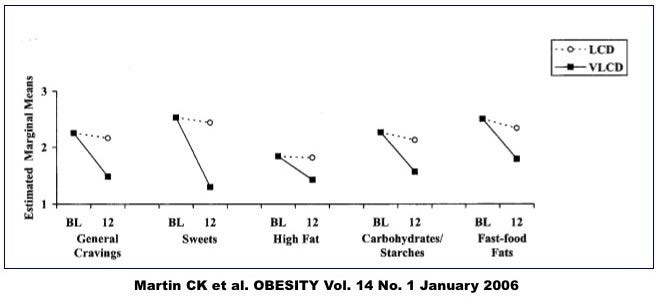
The remaining possibility is thatfood cravings develop due to the consistent association of certain foods with particular stimuli or social contexts (special occasions).This suggests that food cravings are largely a conditioned response (like Pavlov’s dogs).If this is true, then part of the solution is to break these responses.That is, if we can stop eating certain foods for a long time, then those cravings should slowly improve. Is this true? Indeed, it is.
In this study, participants were put on a very low calorie diet — 1200 calories per day in the low calorie group (LCD), and 800 calories per day in very low calorie (VLCD).You can see that severe caloric restriction was much, much more effective at reducing cravings than a higher calorie diet.This is despite the fact that a 1200 calorie diet is already extremely strict.My guess is that even more severe restriction helped to break many of the conditioned responses where the more lenient diet was not powerful enough to do so.The same effect is seen injuice fasting diets where an approximately 800 calorie ‘fasting’ diethelped reduce cravings where low calorie diets alone could not.
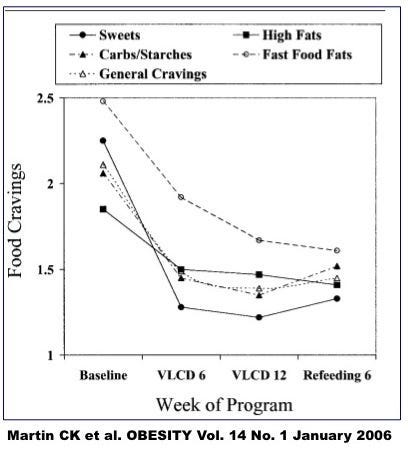
This leads to the counterintuitive fact that we see in our IDM clinic all the time.Eating less, when you go very, very low, makes you LESS hungry, not more hungry.If you have food cravings, then this effect is potentially very important. In the study shown,a 1200 calorie diet was virtually ineffective at lowering cravings where the800 calorie diet reduces it by at least 50%.
This effect is seen for all different types of foods, whether it is sweets, starches, fatty foods, or fast food.Over time, this effect does not diminish, but persists. Once you start re-feeding, the effect starts to dissipate.
This concept extends to hunger. While cravings and hunger are different phenomena, they are clearly correlated to one another, so that decreased cravings can be expected to result in decreased hunger. But keep in mind that this effect is only seen with very severe caloric restriction. In fact, a comparison of a 500 calorie versus a 1200 calorie dieting schedule revealed significantly less hunger in the 500 calorie diet. That is, hunger is less, with less food. Counterintuitive, but consistent.
Amore recent meta-analysis examined this effect in more detail.Reviewing all 8 studies in the literature, they found that interventions lasting at least 12 weeks with caloric restriction consistently showed decreased food cravings.The effect is not huge, but consistent once again for all manners of food — salty, sweet, fatty, or junk foods.People who have cut out certain foods notice this, too.People who reduce their sugar intake very close to zero, for example, find that their sweet tooth goes away.If you eat more sugar, cravings don’t get better — they get worse.It’s like that itch — scratching it won’t make it better — it will make it worse.
The application to fasting is obvious. Severe restrictions on food do not increase food cravings, but consistently decrease them — which is one of the keys to success. This is entirely consistent with our clinical experience. Contrary to almost everybody’s expectation, fasting decreases hunger. Patients would always come back to our clinic and say “I think my stomach shrank. I eat a third of what I used to eat, and feel so full.”
That’s great news, because now you are working with your body to lose weight instead of against it. One of the persistent myths about fasting is that ‘you will get so hungry that you will be forced to stuff your face with Krispy Kreme donuts’. This is why people recommend that you eat 6 or 7 times throughout the day, in order to stave off those cravings. These people obviously don’t have any practical experience, and don’t understand the research which shows exactly the opposite. If you eat constantly, you are more likely to feed those cravings. If you fast, those cravings will shrivel away. Maybe. At least it’s worth a shot.
Dr. Jason Fung

Online Fasting Community and Coaching
For more, check out my YouTube channel, online community and coaching programs at TheFastingMethod.com and my Website & Books
Dr. Fung,
I disagree that high fat (animal or nuts) is an offender for Diabetics as I am. Every one is different to some degree, such as I am... a type two, periodically raging at times, diabetic. Diabetes and Hypothyroid issues resulting from the Irradiation in arming and disarming ThermoNuclear warheads while sitting on the bomb case for 14 months. Damaged DNA. My national fitness winning daughter was born with TWO Uteri. One of 4 recorded women in the world. My other children have had freakish issues also.
None of my 61 family members have diabetes or hypothyroid (two major indicators of irradiation), and I am the most fit of them. Lifting heavy weights and running. I'm more fit at 79 than most 30-year old men.
The high fat content I consume on my carnivore diet, doesn't elevate my blood glucose that I can tell. In the Late Dr. Charles Eugster's book, "Age is Just a Number," his chronicle of a 97 year old weight lifter (him), he promotes high fat (animal) consumption. I do however, stay off long chain carbohydrate (I think that is what they are termed) that turn to glucose quickly.
I have been on my carnivore diet for a few weeks since I started reading your blog and following your advice. It has knocked the Holy Hell out of my blood glucose. Now to keep my blood glucose down, eliminate the excess glucose stored my body from these diabetic medicines and then gradually wean myself from those diabetic medicines.
I will say Dr. Fung, that your articles have given me much more clarity in how diabetes should be dealt with and I commend and thank you. You seem to be one of the few doctors not blinded by Institutes of Higher Learning. Those Institutions kowtow to and are virtually controlled by the Pharmaceutical Companies and influenced totally by massive donations from them.
Their "Science" is bullshytte. People are only a customer to them... only of value to them... unless healthy or dead.
Termini…
Jack Lawson
Member, Sully H. deFontaine Special Forces Association Chapter 51, Las Vegas, Nevada
Author of the “Civil Defense Manual,” “The Slaver’s Wheel,” “A Failure of Civility,” “And We Hide From The Devil” and “In Defense.” Go to www.JackLawsonBooks.com and JackLawsonBooks.Substack.com
I am not a "Bible Thumper" but this is one of the most profound assemblages of words I’ve ever read…
“In the Beginning, before the Earth was made, the Word was there. The Word was God, and the Word was God. He was there with God in the Beginning. Everything was made through Him, and nothing was made without Him. In Him there was Life, and that Life was a Light to the people of the world. The Light shines in the darkness, and the darkness has not defeated it.” – From Jack Lawson’s “Little Brown Book” that I got FREE from PlusNothing.org (actually, I gave $100 to them for the best book I have had in my hands outside of the Bible)
From Jack Lawson… an American in 1RLI Support Commando and attached to Rhodesian “C Squadron” SAS Africa 1976-79
I’ve read your book and it helped me lose weight after I retired. Although I’ve slipped a bit (7lbs) due to an injury, I’m ready to lose those 7lbs. Thank you Dr.